



GM on NEAR in 2½ minutes
Three steps. Zero trust.
Say gm on X
Tweet "gm", "#gm" or "$gm" from the X account you linked. That is the whole job.
Press "check my tweets"
A data provider fetches your timeline from X through an encrypted relay. An OutLayer TEE notary checks the bytes really came from X.
Get $GM. Twice.
GM for the tweet lands right away. Likes are counted at the nightly run and paid on top. Never paid twice.

Why it matters beyond a memecoin: smart contracts can't read the web. Every "post-to-earn" app so far had a server that said "trust me, they posted". GM turns "X's server said this" into something a NEAR contract can check. Any app can reuse it for any website. What's the oracle problem?
The oracle problem, explained with a meme

Every other post-to-earn"Our server checked. You tweeted gm. Trust me bro."
✗
GM on NEAR"A TEE checked X's own TLS bytes, and a NEAR contract accepts answers only from that exact program."
✓How a tweet becomes a proof
One check, six steps. Press play or click through. The 🔒 packets are encrypted the whole way.
The contract asks a question
You press "check my tweets". The GM contract starts an OutLayer job: "fetch @alice's timeline from X". It picks the active provider with the lowest USDC price.
What is OutLayer? ↗Who sees what
| Data | NEAR contracts | Notary in a TEE | Data provider | GM team |
|---|---|---|---|---|
| Provider's X login cookie | no | no | yes | no |
| TLS session keys | no | yes | no | no |
| Raw response from X | no | yes | yes | no |
| Can fake a tweet? | no | no | no | no |
The contract only ever sees the checked result (tweet ids, text, likes). Providers are anyone and the notary is OutLayer's TEE. The GM team runs a tunnel that passes traffic to desktop providers (it can see the parsed result, but the connection to X and the cookie stay end-to-end encrypted inside it) and a gas relayer for sign-up; neither can read a cookie or forge a tweet.
Get paid now. Get paid again at midnight.
A tweet earns GM the moment you check it. Likes keep coming in all day, so they are counted once, at the nightly run at 00:00 UTC. Testnet days are real 24-hour UTC days.

One day, three tweets, zero double-dipping
| Tweet | Checked | During the day | Midnight run |
|---|---|---|---|
| "gm frens" ☕1 pt · 12 likes | 09:12 self-check | +100 GM right away | +12 like points |
| "#gm, shipping today"3 pt · 40 likes | never checked | nothing yet | +3 tweet points +40 like points |
| "$gm to the moon 🚀"5 pt · 250 likes | 18:40 self-check | +500 GM right away | +100 like points (capped) |
The contract stores which tweets it already paid. The midnight run skips the tweet part for those and only adds likes; a tweet you never checked is still picked up and paid in full. Instant rewards are 100 GM per point, capped at half of the day's pool so the nightly split always has GM left. Likes are paid from the day's pool at the midnight run.
Anyone can be the oracle. Even your laptop.
Providers are the people who fetch X pages for the network. They can't cheat (the notary checks every byte) and they can't be spied on (their login stays sealed). They earn USDC per request plus a slice of every day's $GM.
 Easy mode
The desktop app
Setup, the live test, the Live log and how the TEE notary checks every byte. No install needed to see it.
- Download the app
macOS or Linux (no Windows build yet). On a Mac, drag it to Applications.
- Log in to X inside it
Your X session cookie stays on your machine, sealed in its own TLS record.
- Pick a name and a price
Shown in the public provider list. Price per request, in USDC.
- Minimize. Done.
It waits for requests, opens X pages, parses them and gets paid in the background.
macOS won't open the app?
The hackathon build isn't notarized by Apple yet. Open it once, then go to System Settings → Privacy & Security and press Open Anyway. If macOS says the app "is damaged", run this once in Terminal:
xattr -cr "/Applications/GM Provider.app"On Linux: chmod +x the AppImage, then run it.
Hackathon bonus: when you check your own tweets, the request is routed to your own app, so you can watch your laptop do the whole round trip.
Or run it from code
SDKs for Node, Rust, Python and Go. Write one handler per op; the sidecar does the crypto.
import { op, serve, timelineRecords } from '@gmcoin/provider'

// one handler per op: fetch the page through the relay, return JSON
op('x.user.timeline.html.v1', async (task, fetch) => {
  const resp = await fetch({
    headers: [['Accept', 'text/html']],
    secretHeaders: [['Cookie', process.env.X_COOKIE]], // never leaves your box
  })
  return timelineRecords(resp.text()) // SDK helper, or swap in your own parser
})

await serve({ accountId: 'you.testnet' })What would I earn in $GM?
10% of every day's GM pool goes to providers: half split by successful requests, half split equally between every active provider, work or no work. More providers = harder to censor, so just showing up pays.
Plus USDC for every request, at your own price. Example budget only; testnet numbers are set in the contract.
"Is it really encrypted?" Look.
The app shows every request it serves: what was asked, how many encrypted bytes went through, the notary's proof and what you got paid. Your cookie column always reads zero.
- →requestx.user.timeline.html.v1 {"username":"alice"}
- 🔒relayed5,214 bytes ciphertext to syndication.twitter.com:443
- 🍪cookiesealed in secret record · sent in clear: 0 bytes
- ✓proofnotary sig ed25519 9f3a…c41e verified
- ⇢result7 posts extracted · 3 gm tweets
- $paid+0.002 USDC · +1 request toward GM rewards
Who gets the job?
Each provider sets a USDC price per endpoint. The contract routes each request to the cheapest active provider that offers the endpoint and pays it its own price. Race to the bottom, but make it decentralized.
Sign in. Mint anywhere.
Log in without a login server
- NEAR wallets and passkeys: the signature is checked by the contract itself.
- Email (one-time code) and X (OAuth): an OutLayer module checks them and signs the result with a key that only that exact module can use. About $0.002 per login, measured on testnet.
- No Privy, no Auth0, no "trust our backend". Your GM account is your contract record.
$GM on Solana and Base, no bridge team
The bridge contract asks NEAR's MPC signer (v1.signer-prod.testnet) to sign the mint. On Solana the MPC key is the token's mint authority; on Base the ERC-20 mints only on a valid MPC signature. Anyone can post the signed transaction, so no one has to be online and honest. Chain Signatures docs ↗
NEAR feature bingo
Tap the ones you've seen in a hackathon before. We'll wait.
0 / 9
Try it yourself in 5 minutes
- 1Open the testnet app
Sign in with a NEAR testnet wallet, a passkey, email or X. Sign-up gas is on us.
- 2Link your X account
Post the short code the app shows. An OutLayer job finds it by X search and links X to your account.
- 3Tweet "gm" and press Check
Watch the instant reward land (with coins, obviously).
- 4Open your tweet history
Every tweet that earned GM, by day, with what it got and when.
- 5Open Network stats
GM minted, tweets checked, likes, active providers, success rate.
- 6Come back after 00:00 UTC
The nightly run pays your likes on top. The already-paid tweet is not paid again.
- 7Bonus: run the provider app
Your own checks go through your own laptop. Read its request log.
- 8Bonus: send $GM to Solana or Base
Chain Signatures signs the mint on the other chain.
A peek inside the app
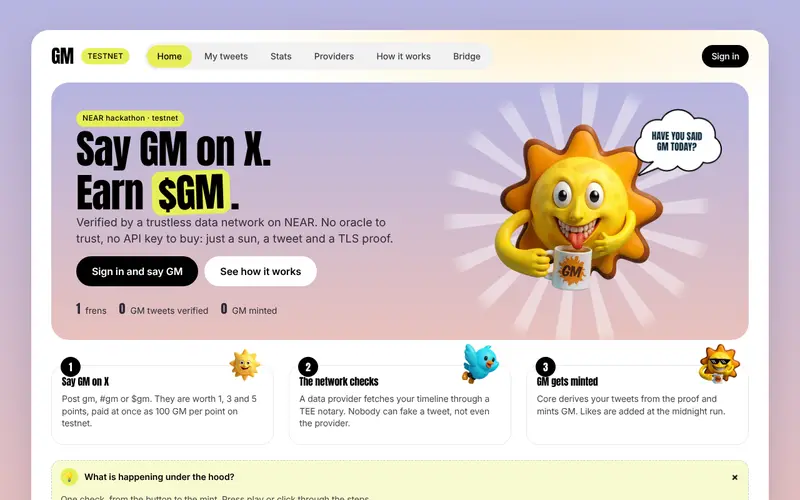 Welcome ↗
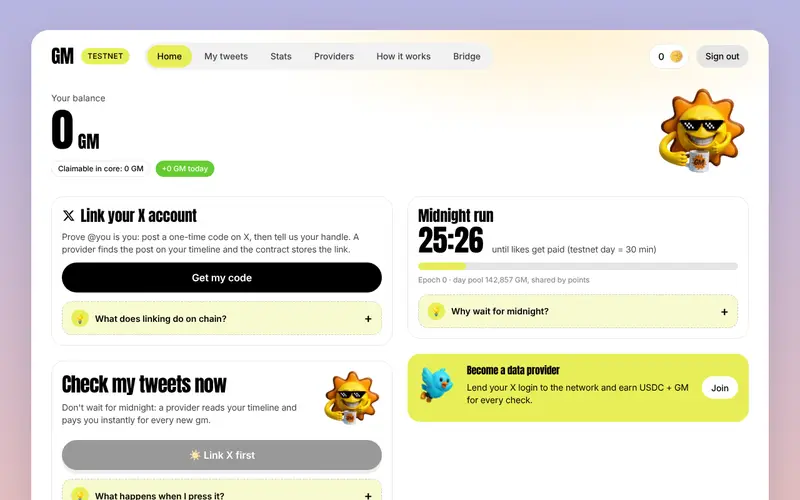 Home ↗
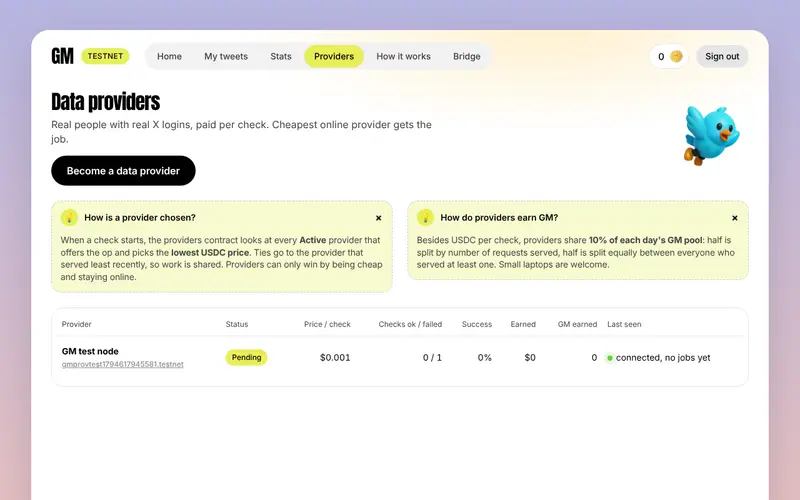 Providers ↗
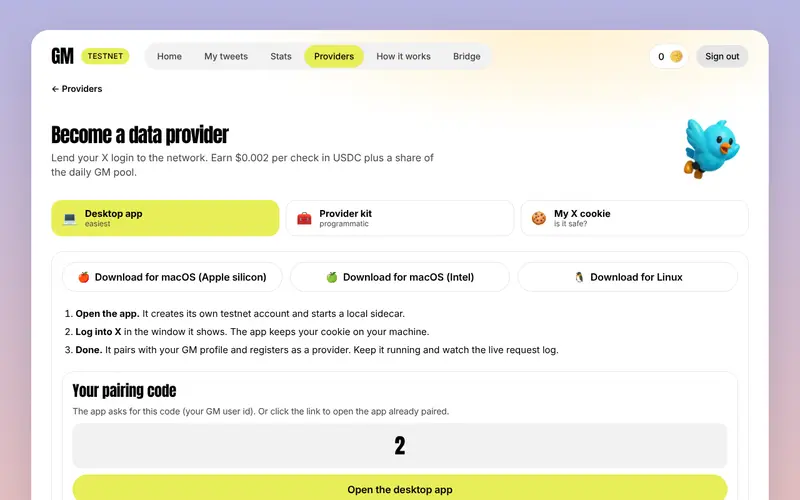 Become a provider ↗
Don't trust this page either. Check the chain.
- Core (users, X links, rewards)core.gmhack-1114b.testnet ↗
- $GM token (NEP-141)token.gmhack-1114b.testnet ↗
- Providers (prices, routing, payouts)providers.gmhack-1114b.testnet ↗
- GM bell (public ticks)bell.gmhack-1114a.testnet ↗
The fine print, honestly
- Everything here runs on NEAR testnet, Solana devnet and Base Sepolia. No real money, no mainnet token yet.
- GM Coin v1 is a live ERC-20 on Base. This NEAR version is a rewrite from scratch for the hackathon: it reuses v1's rules (points, caps, link codes), not its code.
- Testnet days are real days: they end at 00:00 UTC, when the nightly run pays likes.
- Most code was written with Claude Code and reviewed by the team. Libraries are listed in the repo README.